
The Compensation Opportunity: Why AI Is Giving Mid-Sized Firms the Chance to Measure What Actually Matters
AI isn't just changing how legal work gets done — it's giving firms the tools to reward the right behaviors and keep the partners and talent worth keeping.

The Scoreboard Was Never the Game
The leverage pyramid is familiar to every partner at a mid-sized firm: associates generate billable hours sold at rates that significantly exceed their compensation; the spread generates margin; multiply that across dozens of active matters and you have the mechanism driving profits per partner. Compensation systems — hours billed, collections, originations, realization rates — were designed to allocate that surplus.
That model has been durable for decades. It is also built on three measurement assumptions that AI is making obsolete: that time is the scarce input, that revenue reliably proxies value delivered, and that hours supervised approximate margin produced. None of those assumptions survive contact with an AI-enabled delivery model. And in a market where U.S. law firm expenses surged 9% and 9.5% in consecutive years against roughly 2% annual demand growth, the opportunity cost of rewarding the wrong behaviors has never been higher — nor has the upside of getting it right.
The compensation problem is, at its core, a measurement problem. AI has made the right measurement both possible and actionable.
What AI Actually Makes Visible
AI’s most consequential contribution to firm economics is not speed — it is transparency. When AI is embedded in core workflows, the work becomes inherently more structured: tasks are defined, phases are distinguishable, and the gap between expected and actual matter cost becomes visible in ways that legacy timekeeping systems never allowed.
That transparency runs in both directions. Externally, sophisticated clients are demanding it — eight out of ten RFPs now include detailed questions about AI strategy, usage, guardrails, and measurable efficiencies, and nearly two-thirds of in-house legal teams plan to rely less on outside counsel as AI capabilities expand. Internally, when a firm can track matter economics practice group by practice group and partner by partner, the compensation conversation follows naturally.
You cannot run a profitability-aware pricing operation and a revenue-based compensation system simultaneously without the tension becoming visible. The question for mid-sized firm leadership is not whether to move toward profit-based compensation — it is whether to do so deliberately, as a strategic advantage, or to wait until the market makes the choice for you.
Why Revenue-Based Compensation Is the Wrong Scoreboard
In a revenue-based system, AI-driven efficiency creates three distortions — all correctable with deliberate redesign:
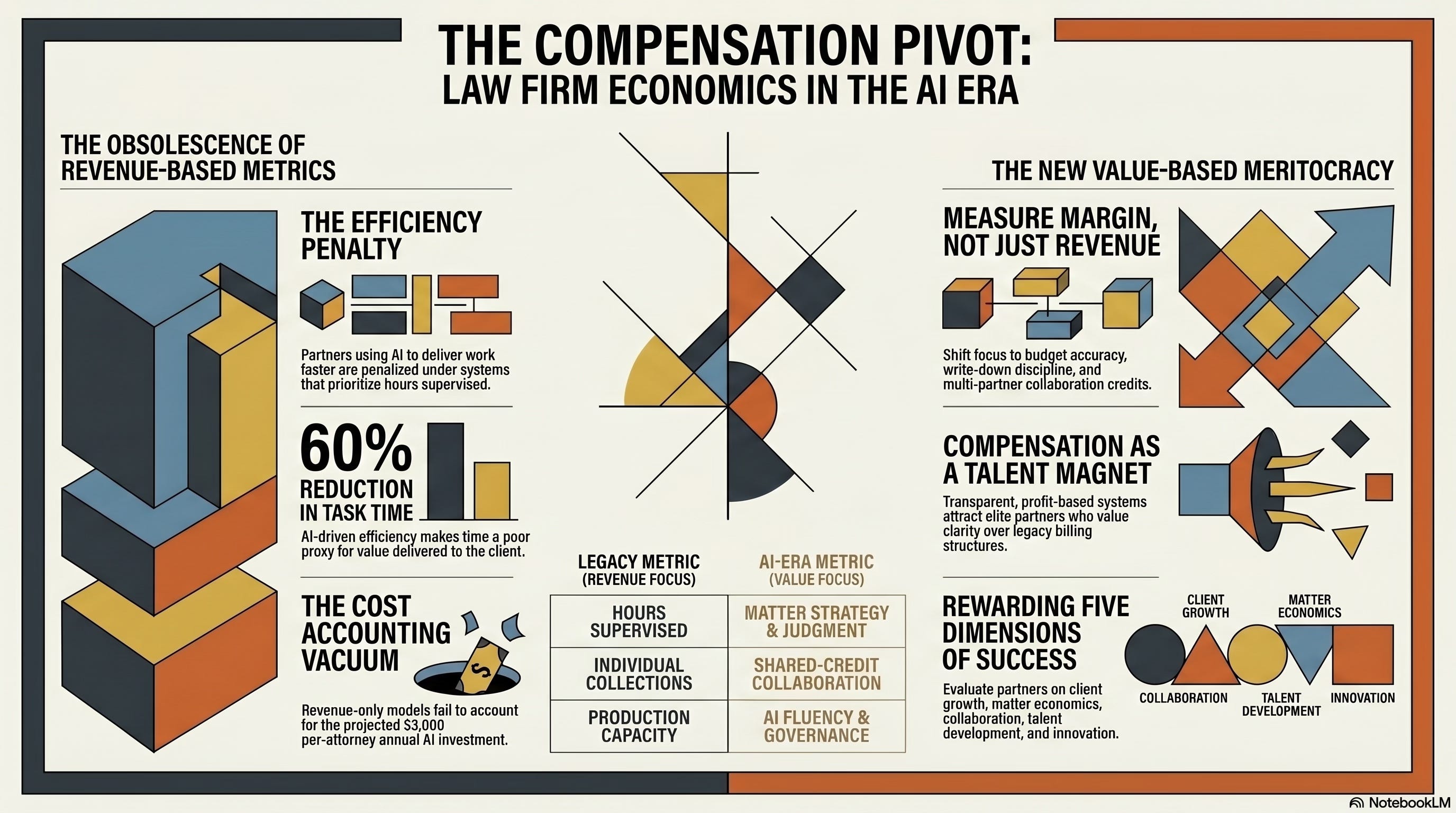
• The efficiency penalty. A partner who deploys AI and delivers a matter in 60% of legacy time creates better client value and stronger pricing confidence. Under a system measuring hours supervised and collections, that partner risks being penalized twice: fewer hours on this matter, a smaller production pool on the next. The partner who staffs heavily and writes down generously at the end may look better on paper. That is a system rewarding the wrong people — and firms that redesign it first will attract the efficiency-minded partners every competitor is now pursuing.
• The pricing accountability gap. Fixed fees backed by AI-enabled scope analysis and historical data offer something hourly-billing competitors cannot match. But if the partner who delivers a fixed fee profitably is compensated identically to the partner who bills hourly and writes off 20%, the system passively resists the pricing transformation the firm needs.
• The cost accounting vacuum. AI investment is projected to nearly double in 2026, from approximately $1,400 per attorney to nearly $3,000. A compensation system with no mechanism for allocating that investment — and no way to credit the partners generating the productivity gains it enables — makes capital allocation decisions blind.
The right model structures compensation around origination, client expansion, and value delivered — not hours supervised. That is not a boutique philosophy. It is what profitability requires in the AI era.
The Forcing Function: Alternative Pricing Requires Cost Discipline
The compensation conversation and the pricing conversation are the same conversation.
Reliable fixed-fee pricing requires actuarial confidence, which requires historical matter data. The infrastructure that makes alternative pricing viable — AI-powered precedent banks, closing set libraries, structured matter data — also makes visible which partners scope accurately, manage to budget, and deliver predictable outcomes, and which ones generate write-downs that erode margin without ever appearing as a performance issue under a revenue-based review.
Aligning partner compensation with originations, cross-selling, and value delivered rather than hours supervised requires transparency: partners need to understand not only what is changing but why. Firms that provide that clarity will not just manage the transition better — they will attract the partners who have been waiting for a firm to have this conversation honestly. The structural tension between stated goals and actual incentives is not a character flaw. It is a design problem, and it is eminently correctable.
Compensation as a Talent Magnet: The AI Portability Opportunity
This is the argument most compensation discussions in legal miss — and it may be the most important one.
AI makes partner books of business dramatically more portable. Historically, a departing partner faced real friction: rebuild a team, negotiate technology contracts, establish operational capacity. AI substantially reduces that friction. A rainmaking partner evaluating departure faces a very different calculus than five years ago. The same is true of associates: an ambitious fourth-year who can manage AI workflows and deliver consistent client value no longer needs a large firm infrastructure to be productive.
This is a risk. It is also the clearest possible argument for why compensation system design is now a primary talent strategy, not a secondary administrative function.
Firms with transparent, merit-based compensation systems visibly tied to the behaviors that create durable value are sending their best people a clear signal: we see what you actually do, and we pay for it. In a market where leaving has never been easier to execute, that message retains the partners worth keeping and recruits the partners worth attracting — who are, by definition, the ones with the most choices.
The associate raised inside the firm is also the partner hardest to poach. A compensation system that credits partners for developing the talent the firm needs — rather than merely extracting from it — compounds talent over time and converts AI portability from a threat into a structural recruiting advantage. Firms that can clearly articulate what partnership looks like in the AI era — what it rewards, what it values, what the path looks like — are offering something increasingly rare in the lateral market: clarity. And to a talented senior associate evaluating options, clarity is a competitive differentiator.
The Cultural Opportunity: Profit-Based Compensation That Builds Cohesion
The tension in this redesign is real and worth naming. The same cost visibility that enables profit-based compensation can, if mishandled, convert a partnership into a fragile cost-sharing arrangement — where “we’re building a firm together” sounds like a fundraising pitch, cross-selling becomes transactional, and committed partners begin calculating whether the institutional premium is still worth paying.
This outcome is not inevitable. It is a design choice.
When every firm has access to comparable AI tools, what separates them is almost entirely cultural: supervision rigor, commitment to client relationships, mentorship quality, and ethical seriousness about AI governance — assets that cannot be licensed, purchased, or reverse-engineered. A compensation system that treats profit as a lens rather than a verdict, using margin data to inform multi-dimensional evaluation rather than reduce every partner to a number, builds the conditions where transparency strengthens rather than corrodes the partnership. That system tells a story: we measure what matters, we reward what lasts, and we invest in each other because the institution compounds value that none of us could generate alone.
That is the story that retains the partners worth keeping and recruits the partners worth attracting.
What Profit-Based Compensation Actually Requires
Moving from revenue-based to profit-based compensation is a sequenced set of choices about what to measure, how to attribute it, and how to build the institutional trust that allows data to inform decisions rather than weaponize them.
Define “profit” precisely. Standard internal cost rates for timekeeper effort, consistent treatment of AI tool costs, and explicit allocation of shared infrastructure are the precondition for any credible profitability conversation — and a clear signal to prospective laterals that the firm measures performance fairly.
Use profit as one dimension, not the only one. A well-designed partner scorecard rewards five areas:
• Client franchise — retention, growth, satisfaction
• Matter economics — budget accuracy, margin performance, write-down discipline
• Collaboration — shared-credit models, multi-partner account stewardship
• Talent development — building next-generation partners and AI-fluent associates
• Innovation — knowledge assets, playbooks, AI workflow contribution
Partnership criteria should be redesigned explicitly around AI-era competencies: demonstrated AI fluency and governance leadership; client relationship development tracked from year two; matter strategy contribution; and cross-functional collaboration. Firms that build and communicate this scorecard clearly are not just managing behavior — they are recruiting for it.
Add volatility controls. Profitability swings for reasons unrelated to partner quality. Protect system integrity — and signal that the firm measures performance over a career, not a quarter — through:
• multi-year rolling averages,
• caps on year-over-year compensation movement, and
• explicit investment credits for practice-building work that depresses short-term margin.
Associate Compensation: Move from “Hours = Worth” to “Capability = Worth”
AI creates a twin challenge for associate economics: fewer billable hours in automated task categories, and fewer repetitions of the foundational work that historically trained judgment. If partner compensation shifts toward profit while associate evaluation remains hours-based, talented associates will notice the contradiction — and in a market where mobility has never been easier, that misalignment is a retention problem waiting to happen.
The value that endures through the AI leverage shift is not the capacity to produce work product — AI does that now — but the capacity to evaluate it, contextualize it, and be accountable for it. Associate compensation and advancement criteria should reward:
• quality of judgment and review
• matter strategy contribution
• client communication and responsiveness
• AI governance execution
• knowledge asset development (checklists, model clauses, workflow design)
• early business development activity
Reviews should incorporate client feedback, documented strategy contributions, and AI governance performance. Structured mentorship — partners assigned not just for supervision but for deliberate professional development, client introductions, and business development modeling — is not a cost. It is the talent pipeline that makes the firm viable in 2033, and the recruitment story that attracts associates who want to build something rather than just bill hours.
Mid-sized firms that make this investment deliberately will discover something counterintuitive: they haven’t just navigated the disruption. They’ve built a talent pipeline that competitors optimizing for short-term margin have quietly destroyed.
A Transition Architecture That Strengthens Rather Than Disrupts
Compensation redesign succeeds as a culture and talent strategy, not an accounting exercise. A sequenced approach:
1. Build transparency first (2–3 quarters). Show profitability dashboards without connecting them to pay. Partners will engage with and debate the data — building the shared fluency that makes every subsequent conversation possible, and signaling to every talented person in the firm that leadership is serious about measuring the right things.
2. Anchor in pricing governance, not partner reviews. When cost discipline is introduced as a client service tool — enabling fixed-fee scoping, improving pricing accuracy — partners experience it as a competitive capability rather than surveillance.
3. Introduce profit-weighted modifiers gradually and announce the trajectory. Start at 10–20% of variable compensation. Commit publicly to where the system is going. Clarity about direction is itself a recruitment asset.
4. Redesign origination credit for modern delivery. In an AI-augmented firm, the partner who scopes, the partner who deploys the workflow, and the partner who holds the client relationship may be different people — all three created value. Shared credit models and delivery leadership recognition are the infrastructure for cross-practice collaboration that makes a mid-sized firm more valuable than the sum of its practices.
5. Align associate incentives in the same cycle. Misalignment between partner and associate metrics will surface immediately in staffing behavior, training investment, and attrition of the associates with exactly the AI-era competencies the firm needs.
The Strategic Choice You Can Make Now
Two options, and the choice cannot be deferred indefinitely.
Preserve the traditional system as long as the market allows — maintaining billing structures that ignore AI efficiency, managing margin pressure reactively — and watch the talent calculus shift quietly against you: declining realization, growing write-downs, and competitive loss to firms that have already adjusted.
Or recognize that whether AI compresses midsize firm margins or amplifies competitive advantages depends less on technology than on pricing clarity, client transparency, and organizational culture. None of those three things is achievable with a compensation system designed for a world that no longer exists.
The steps required are concrete. No regional firm needs to become a technology company. What is required is leadership willing to measure what actually matters, pay for what the firm actually needs, and communicate clearly enough that the best people in the market can find them.
The compensation redesign is not a separate workstream from the AI adoption strategy. It is the AI adoption strategy’s internal infrastructure — the mechanism that converts platform investment into practice transformation, and turns talent portability from a threat into a recruiting advantage.
The firms that get this right will not necessarily have the most sophisticated technology. They will have built the most capable and confident partnership around it.
The time for observation has passed. The time for action is now.
This is the eighth installment of The Strategic Law Firm’s series on AI-driven transformation at mid-sized law firms. Previous pieces covered the competitive squeeze (No. 1), the collapse of the leverage pyramid (No. 2), the reinvention of business development (No. 3), greenfield firm design (No. 4), the associate paradox (No. 5), the change agent problem (No. 6), and the attorney-client relationship in the AI era (No. 7). The next piece will address AI governance: not as a compliance checkbox, but as a strategic and cultural differentiator.
The views expressed are the author’s own and do not represent the views of the author’s firm or its management.
Endnotes
6. Citi Global Wealth at Work Survey Data, summarized in Aebra Coe, Costs Are Pushing Law Firms In A Corner Amid Consolidation, Law360 Pulse (Mar. 9, 2026).
7. Thomson Reuters Institute, 2024 Generative AI in Professional Services Report; Stanford CodeX benchmark studies (60–80% time reductions on document-intensive tasks).
8. Law360 Pulse, Corporate Clients Want Receipts On Law Firm AI (Feb. 25, 2026); Association of Corporate Counsel survey data cited therein.
9. Perkins & O’Neil, Rethinking Legal Pricing, Mastering Legal Pricing (2025); WLLC Fall Roundtable AI Survey (2025) (AI investment data).
10. ABA Standing Committee on Ethics and Professional Responsibility, Formal Opinion 512, Generative AI Tools (2024).
11. Steven Lerner, Legal Enters ‘AI Slop Phase’ As Atty Replacement Fears Loom, Law360 Pulse (Mar. 9, 2026) (quoting Danielle Benecke, Baker McKenzie, Legalweek 2026).
12. Enrique Hernandez, The Associate Paradox (No. 5) and The Change Agent Problem (No. 6), The Strategic Law Firm (Apr. 2026).