
The Pricing Reckoning: Why Changing Your Fee Model Means Redesigning Your Firm
Changing what you charge is the easy part. Changing how you evaluate performance, compensate partners, and forecast revenue — that's the actual work.

There is a question that keeps surfacing in conversations across the industry: among peers, at conferences, in candid calls after someone has read one of the earlier pieces in this series:
“We know we need to move away from the billable hour. But every time we try to have the conversation seriously, it stalls. Where do we actually start?”
It’s a fair question. And it is not rhetorical. The firms grappling with it, many of them between 50 and 200 attorneys, have watched their margins compress, their clients ask harder questions about AI discounts in RFPs, and their most productive partners experiment with fixed fees on a matter here and there, without any governing logic behind the pricing, no supporting data infrastructure, and no idea how to evaluate performance under the new model.
The issue isn’t a lack of understanding that pricing needs to change. Most of us get that.
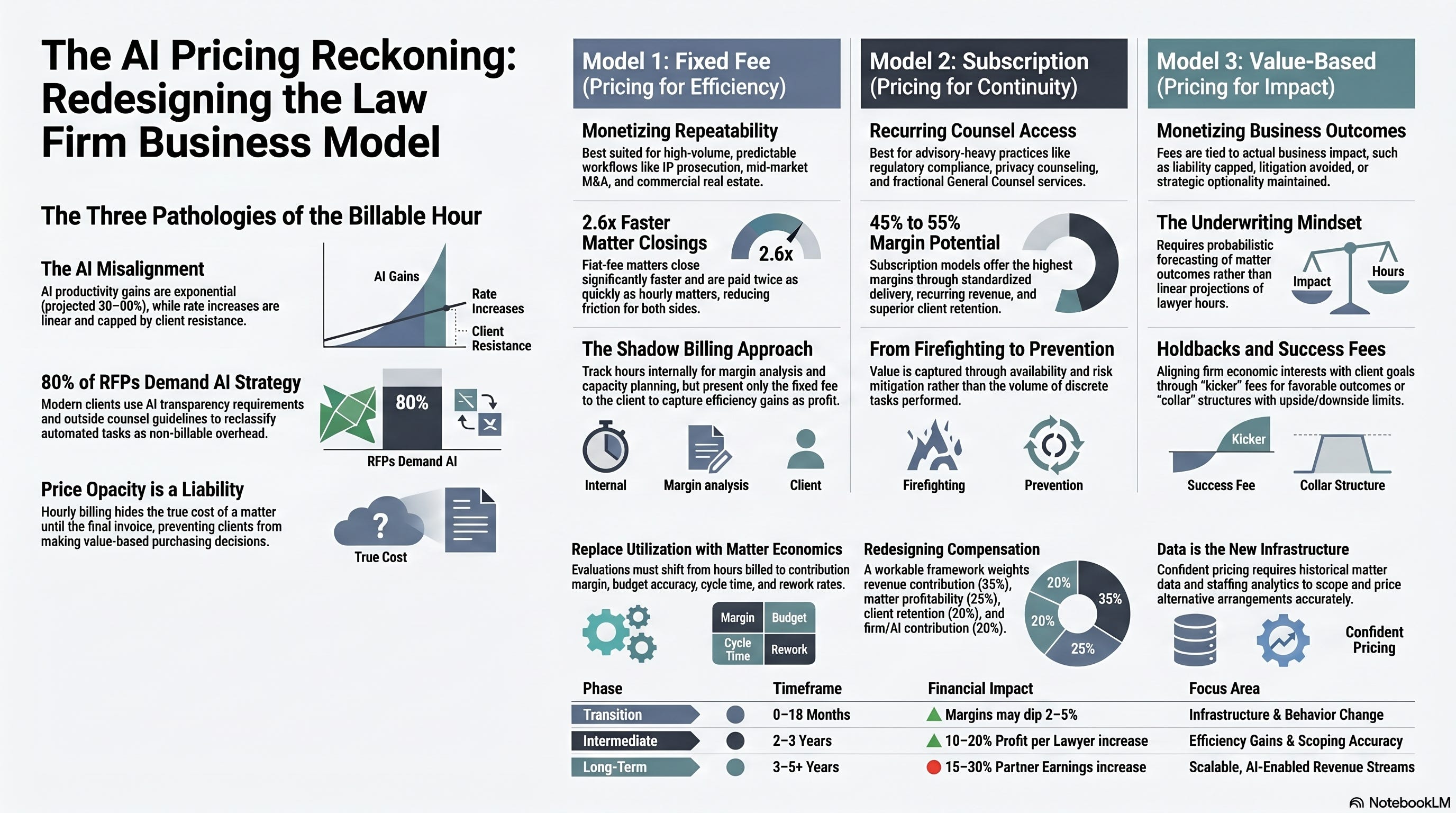
The issue is that what looks like a pricing initiative is actually a business model transformation, and that distinction hasn’t always been drawn sharply enough. The billable hour becomes selective. Flat fee plus shadow billing becomes core for specific practice groups. Subscription becomes standard for advisory. This is a structural redesign, not merely a pricing recommendation.
That distinction is where most of us get stuck, and where this article picks up.
What the Billable Hour Actually Is
The leverage pyramid is often understood instinctively: equity partners at the top, supported by non-equity partners and associates below. What is less often stated plainly is that this structure is not just an organizational chart. It is a financial engine. Associates generate billable hours sold to clients at rates that significantly exceed their compensation, and the spread generates margin.
But the billable hour is more than a revenue mechanism. It is, in practice, the firm’s operating system: the thing that every other decision runs on.
It determines:
• How attorneys are evaluated. Hours billed, hours supervised, realization rate.
• How partners are compensated. Origination credit, hours worked, leverage ratios.
• How revenue is forecasted. Hours × rates × attorneys = projected revenue.
• Who gets promoted. Years of logged production, usually measured in billable time.
• Who bears risk. Under hourly billing, if the matter runs long, the client pays. Scope risk transfers automatically.
There is a further structural consequence that is often underappreciated: hourly billing makes the total cost of a matter unknowable at the outset. Unlike virtually every other professional service engagement, the client who retains a firm on an hourly basis cannot know what the matter will cost until it is over. The hourly rate is visible, but the total price is a function of variables the client cannot observe or control: how many hours will be required, how many timekeepers will touch the file, how much rework will occur, and how aggressively the bill will be managed before it is sent.
This opacity has a second-order effect that is strategically significant: it prevents meaningful comparison shopping. A client evaluating two firms on an hourly basis is comparing rate cards, not prices. The actual cost of the engagement remains speculative until the final invoice, which means that clients lack the information necessary to make informed purchasing decisions based on value. In most markets, that kind of opacity would be a competitive vulnerability. In legal services, it has persisted because the entire industry has operated on the same model. That is changing.
This is why the billable hour has proved so durable, and why it is so difficult to change. The leverage pyramid is not just an organizational chart; it is a financial engine. Partners who have spent careers building their position within that structure have understandable reasons to be cautious about change, even when they intellectually recognize its necessity.
The caution is human and reasonable. It is also, at this point, a competitive liability.
The Three Pathologies
The billable hour generates three structural problems that pricing reform is meant to address. Understanding them precisely matters, because each one has a different cure.
1. Price opacity.
Hourly billing looks transparent because the unit price, the hourly rate, is visible. But the actual price of a matter is a fog of second-order variables: scope uncertainty, negotiated rate discounts, pre-bill write-downs, and realization gaps. Clients see the rate card but experience the surprise. As I have written throughout this series, sophisticated clients are already asking harder questions: “What percentage of your billed hours last year involved tasks AI can do in a fraction of the time? And are your invoices reflecting that?” According to recent industry data, eight out of ten RFPs at major firms now include detailed questions about AI strategy, usage, guardrails, and measurable efficiencies.
And the pressure is not limited to RFPs. Clients now deploy at least four distinct levers to capture AI-driven savings: the RFP process itself, which increasingly selects for AI-enabled firms willing to pass efficiency gains along; expanded outside counsel guidelines that reclassify AI-automatable tasks as non-billable; AI transparency requirements demanding detailed reporting on how and where AI was used on a matter; and the credible threat of insourcing, as corporate legal departments adopt AI tools internally and reduce their dependence on outside counsel altogether.
The speed of this shift is striking. Two years ago, the prevailing client instruction was “do not use AI on our data.” Today, the message has reversed: “We expect you to use AI and pass along the savings.” General counsel are under direct CEO pressure to cut legal budgets by as much as 30%, and they are looking for firms that can help them get there. Price opacity is becoming unsustainable.
2. Scarcity constraints.
When the product is hours, revenue growth becomes a math problem: more hours, more people, or higher rates. The amount of work U.S. law firms perform for corporate clients has grown at roughly 2% per year over the last decade, while expenses surged 9% and 9.5% in two years alone, and average lawyer productivity has declined by 73 hours over the past decade. Demand is flat. Costs are soaring. Productivity is sliding. Firms have compensated by leaning on the only lever that does not require more human bandwidth: aggressive rate increases. That strategy has worked longer than it should have. It is running out of road.
But the scarcity problem runs deeper than flat demand and rising costs. The billable hour system is itself a scarcity engine. Because compensation, advancement, and professional standing are all indexed to hours billed, the system creates a structural incentive for lawyers to maximize time spent billing, often at the direct expense of personal health, family life, and long-term wellbeing. The result is a profession that selects for endurance over excellence and rewards presence over productivity. This has always carried a human cost. What has changed is that the cost now has a competitive dimension: newer generations of lawyers, who place materially greater weight on lifestyle, autonomy, and sustainable working conditions, are increasingly unwilling to enter or remain in a system that treats burnout as a feature rather than a defect. The talent pipeline is narrowing not because there are fewer qualified candidates, but because the economic model repels them. The consequence is a self-reinforcing cycle: fewer lawyers willing to practice under billable hour conditions means greater scarcity of legal services, which in turn supports higher rates, which in turn reinforces the very model that created the scarcity in the first place.
AI has the potential to break this cycle. By multiplying the output capacity of each lawyer by orders of magnitude, AI-enabled legal services can dramatically expand the effective supply of legal work product without requiring a proportional increase in the number of practicing attorneys. In theory, this should exert sustained downward pressure on pricing. In practice, however, two countervailing forces may limit that effect. First, if the broader economy continues to grow and regulatory complexity continues to increase, demand for legal services may expand in tandem with or faster than the AI-driven increase in capacity.
Second, and more fundamentally, the supply of licensed attorneys remains constrained by bar admission requirements, jurisdictional licensing rules, and the unauthorized practice of law framework, all of which function as barriers to entry that give the profession characteristics of an oligopoly. AI can make each lawyer vastly more productive, but it cannot, under current rules, create new lawyers. If demand growth outpaces the expansion of effective supply, even in an AI-augmented market, the pricing power of licensed practitioners may prove more durable than current projections assume.
The strategic implication for firms is significant: the transition away from hourly billing is not merely a response to margin compression. It is a repositioning for a market in which the unit of scarcity shifts from the lawyer’s time to the lawyer’s judgment, and in which the firms that price for judgment rather than hours will capture the premium that scarcity continues to support.
There is a corollary to this analysis that deserves emphasis. If the transition away from hourly billing succeeds, and if AI enables lawyers to deliver equivalent or superior output without the relentless time-based production demands of the current model, the profession may become structurally more attractive to the very talent pool it has been losing. A practice environment in which compensation is tied to judgment, quality, and outcomes rather than to the sheer volume of hours logged is one in which sustainable work-life balance becomes not merely tolerable but economically rational. For a generation of lawyers who have watched their predecessors sacrifice health, family, and personal fulfillment in service of billable hour targets, that shift may prove decisive. The firms that build AI-enabled, output-oriented practices may find that they are not only more profitable but also more capable of attracting and retaining the next generation of legal talent, reversing the scarcity cycle rather than perpetuating it.
3. The AI misalignment.
This is the most urgent problem, and the one that makes the other two acute. AI compresses time-on-task. When a research project that once took eight hours takes one, honest billing reflects that, and sophisticated clients are already asking whether AI was used and whether the bill reflects the efficiency.
The trajectory of these gains matters: current AI-driven productivity improvements are modest, roughly 10%, but projected gains accelerate sharply, 30% within two years, and potentially 80% within three as agentic AI matures and firms move beyond experimentation to systematic deployment. Rate increases, by contrast, are capped at roughly 10% annually before clients push back. The math is unforgiving: productivity gains are exponential while rate increases are linear.
There is a further constraint that firms have not fully internalized. Under prevailing ethics rules, AI compute costs are treated as disbursements, not as billable professional time. A firm cannot mark up the cost of running an AI tool the way it marks up an associate’s time. This means that as AI performs an increasing share of the substantive work, all margin continues to depend on human hours, but there are fewer human hours to bill. The correct response is not to hide AI use or bill at legacy rates while pocketing the gains. The correct response is to build a pricing strategy that monetizes the AI leverage shift.
As one employment lawyer with her own firm put it plainly: “The work that once required a first-year associate now takes six minutes with the right tools instead of two hours. That’s not a productivity gain, that’s a business model disruption.”
The billable hour prices inputs. AI increases output per input. The gap between those two facts is now visible enough to clients that it cannot be managed quietly any longer.
The Core Problem With Pricing Initiatives That Don’t Go Far Enough
Most firms that attempt alternative fee arrangements make the same mistake: they treat it as a billing option added on top of an existing system, rather than a redesign of the system itself. A partner offers a fixed fee on a matter. The matter closes. The firm has no idea whether it was profitable. The partner has no data to scope the next one more accurately. The compensation committee has no framework for evaluating performance under a non-hourly matter. And the forecasting team has no mechanism to project revenue from a growing fixed-fee portfolio.
If an evaluation and compensation system rewards hours supervised and billable production, and AI reduces the hours required per matter, there is a structural tension between the firm’s stated goals and its actual incentives. This is not a character flaw. It is a design problem, and it is correctable.
The corrective design runs across five systems simultaneously: pricing architecture, performance evaluation, compensation, revenue forecasting, and the data infrastructure that ties them together. Each one must change. Changing only one produces incoherence — and incoherence produces the stalling that every partner group knows well.
What follows is a framework for each of the three primary alternative models, built around the four questions that matter most in practice.
Model One: Fixed Fee (Per Matter, Per Phase, or Per Deliverable)
What value does it capture?
Fixed fees monetize efficiency and repeatability. They capture value when a firm can reliably scope the work, reuse precedents and established processes, staff at the right level, and avoid rework. In other words, fixed fees reward the firm for having built a legal production system, not for producing effort.
Practices that rely on high volume, repeatable workflows, and standardized outputs will commoditize rapidly. AI tools have already achieved 20 to 40% time reductions in patent prosecution, first-pass contract review, and document diligence. In these categories, margin compression is not a future risk — it is already underway. Fixed fees are the mechanism by which a firm gets ahead of that compression and turns efficiency into margin rather than surrendering it.
The internal mechanics matter here. One model worth understanding, which might be called the McKinsey shadow billing approach, runs as follows: track hours internally, charge a flat fee externally, analyze margin, and adjust pricing over time. The firm never loses visibility into its cost structure; it simply stops presenting that cost structure to clients. This is not a novel concept. Major management consulting firms, including McKinsey, BCG, and Bain, have operated precisely this way for decades: tracking internal hours for staffing, capacity planning, and profitability analysis while never presenting those hours to clients. The fee is the fee; the internal data is a management tool, not a billing instrument.
One tactical nuance deserves emphasis: on fixed-fee matters, the shadow-billed amount should slightly exceed the fixed fee. Clients will inevitably compare the flat fee to what they would have paid on an hourly basis, and if the shadow billing demonstrates that the hourly equivalent would have been higher, the client perceives value and the firm reinforces the case for the arrangement. Blended rates, discussed below, can assist in achieving this result.
The empirical case for this approach in legal services is strengthening. Industry data indicates that flat-fee matters close 2.6 times faster and are paid nearly twice as quickly as hourly matters, suggesting that the removal of hourly billing friction benefits both sides of the engagement. Legal pricing strategists, including Toby Brown and Stuart Dodds, have written extensively on the importance of maintaining internal time data for pricing intelligence even when the external model is non-hourly. The shadow billing model preserves the actuarial intelligence of time tracking while removing the perverse incentive to slow down.
From a practice-by-practice perspective, the strongest candidates for fixed-fee adoption are those with predictable, process-driven work. The core of IP prosecution work, including patent and trademark prosecution, is highly process-driven, repeatable, and predictable, making it well-suited for flat-fee and portfolio pricing structures. Clients in this space are accustomed to fixed pricing per filing, office action response, and portfolio management, and increasingly expect cost certainty. The same logic applies to mid-market M&A transactions, standard employment packages, and commercial real estate closings.
A hybrid model, with increased use of flat fees for repeatable mid-market transactions while maintaining hourly billing for more complex matters, allows the firm to capture efficiency gains in repeatable work while preserving margin and flexibility in higher-risk matters.
Two additional fixed-fee variants merit consideration. Menu-based pricing assigns a fixed price to discrete deliverables, such as a deposition at a defined fee, a motion to dismiss at another, an office action response at another, allowing clients to understand the cost of each component before authorizing the work. Portfolio pricing bundles similar matters across a client relationship, offering volume-based predictability and enabling the firm to smooth margin across a portfolio rather than pricing each matter in isolation.
Both structures can be layered with multi-year discount schedules, for example, a 10% discount in year one, 20% in year two, and 30% in year three, that reward client loyalty while reflecting the firm’s improving efficiency as AI-enabled workflows mature and historical data accumulates. The progressive discount structure also functions as a retention mechanism: the client’s incentive to stay deepens over time, and the firm’s cost-to-serve declines in parallel.
One important caution: fixed-fee pricing for litigation should remain selective and targeted. Litigation is inherently driven by factors outside the firm’s control, including court schedules, procedural developments, opposing counsel strategy, and evolving factual records. These variables make it difficult to accurately scope matters at the outset and create significant risk. In addition, litigation work is highly dependent on real-time strategic judgment at the partner level, which continues to align most appropriately with an hourly pricing framework. The exception is where discrete phases can be reliably scoped, such as early case assessment, specific motion practice, or defined discovery phases where history provides a reliable pricing anchor.
One immediate tactical move that bridges hourly and fixed-fee pricing deserves mention: the blended rate. Under a blended rate arrangement, the firm charges a single rate regardless of which attorney performs the work. This enables what might be called “downshifting”: work that would traditionally have been performed by a partner can be handled by an AI-enabled associate at the same rate, improving the firm’s margin while maintaining the client’s cost expectations.
Blended rates also simplify the client’s budgeting process and, when combined with shadow billing on fixed-fee matters, can produce favorable hourly-equivalent comparisons that reinforce the value of the flat-fee arrangement. For firms not yet ready to move entirely to fixed fees, blended rates offer a meaningful intermediate step that begins to decouple revenue from the identity of the timekeeper.
How do you evaluate attorney performance under fixed fees?
Hours cannot be the north star. Replace utilization metrics with matter economics and delivery excellence:
• Contribution margin per matter (fee collected minus direct attorney cost and allocated overhead)
• Budget accuracy (variance between planned internal cost and actual internal cost)
• Cycle time (time from matter open to billing milestone)
• Rework rate (how often work must be revised; client-initiated corrections)
• Scope discipline (using defined change-order protocols rather than silent over-delivery)
• Client satisfaction and repeat engagement
Restructuring the metrics driving compensation and promotion to include matter efficiency, meaning value delivered per dollar billed, quality of AI deployment, client satisfaction on AI-assisted matters, and business development tied to AI-enabled service offerings addresses the underlying tension directly: if completing a contract review in two hours rather than twelve means billing less and being evaluated less favorably, the firm’s incentive structure is working against its stated goals.
How do you compensate attorneys fairly?
The compensation goal is to avoid two perverse incentives: winning by under-serving the client (protecting margin by cutting corners), and winning by hoarding work (protecting personal credit at the expense of team throughput).
A workable framework for fixed-fee environments allocates compensation weight as follows: Revenue contribution (35%), matter profitability (25%), client value and retention (20%), and firm contribution (20%). This better reflects how value is created in an AI-enabled, increasingly non-hourly environment.
Breaking down what each component actually rewards:
• Revenue contribution (35%) focuses on collected revenue, not billed time, reinforcing accountability for originations and matter ownership rather than raw hours.
• Matter profitability (25%) rewards efficient delivery, proper scoping, and effective use of AI and staffing, the behaviors that make fixed-fee pricing financially viable.
• Client value and retention (20%) encourages long-term relationships, cross-selling, and client satisfaction, the compounding asset that hourly billing has structurally undervalued.
• Firm contribution (20%) credits non-billable but high-impact activities: AI adoption, knowledge management, mentoring, and innovation. Many firms are providing billable hour credit to learn more about these tools and how they will benefit their practice.
The result is a 15 to 30% or greater increase in partner earnings without requiring more hours. The model is designed to increase, not reduce, partner compensation over time, which is the only argument that will move a partner compensation committee in practice.
How do you forecast revenue reliably?
Fixed-fee forecasting shifts from “hours pipeline” to matter pipeline. The mechanics:
• Build a matter taxonomy — type, phase, complexity tier.
• Use historical matter data to establish expected internal cost bands, expected cycle times, and expected realization risk.
• Forecast revenue as number of matters multiplied by expected fee, timed by phase completion schedules or billing milestones.
• Maintain a risk reserve for outliers, particularly in the early transition period.
Reliable fixed-fee pricing requires actuarial confidence, which requires historical matter data. That is why firms investing in AI-powered knowledge management, making precedents, closing sets, and brief banks searchable, are not pursuing a records project. They are building the infrastructure that makes alternative pricing viable.
The data investment is not optional. Build the data foundation for pricing transformation: historical matter data, staffing ratios, and pricing analytics that enable accurate fixed-fee scoping. Without that data infrastructure, firms cannot price confidently — and confident pricing is what separates proactive proposals from reactive discounting.
On transition timing: expect the first 12 to 18 months to run at break-even or slightly below on fixed-fee matters. Margins may compress 2 to 5% in the first 12 to 18 months during transition due to learning curves in scoping, investment in pricing and data infrastructure, and compensation model adjustments. However, firms that execute well typically recover and exceed prior margins as efficiency gains traction.
Model Two: Subscription (Recurring Counsel Access)
What value does it capture?
Subscription pricing captures value from availability, continuity, and prevention. Clients pay for ongoing access to counsel, reducing the friction of initiating outside engagement, enabling proactive rather than reactive service, and monetizing the advisory relationship itself rather than individual tasks within it. The value proposition is often “fewer fires,” not just faster firefighting.
The subscription model applies to employment advisory, regulatory and compliance counseling, privacy counseling, and general counsel services, structured as tiered subscriptions with predictable monthly pricing.
The strongest fit is with practices that are heavily advisory in nature, involving ongoing client counseling, compliance guidance, and risk mitigation. Clients in this area typically seek continuous access and predictability rather than matter-based billing. This makes the practice particularly well-suited for subscription pricing, which aligns with how clients experience and budget for these services.
One nuance worth naming directly: subscription pricing does not fit litigation as a primary model, but it does fit the advisory layer that surrounds litigation. The subscription model is best deployed for the ongoing, non-case-specific work that surrounds and feeds litigation, including pre-dispute counseling and risk mitigation, ongoing employment or regulatory advice, early-stage dispute assessment and strategy, routine motions and guidance, and portfolio-level oversight of multiple matters.
Midmarket clients consistently rank pricing predictability among their top concerns. Midsized firms are already more likely than smaller firms to offer subscription pricing — leaning into that advantage signals both confidence and sophistication.
How do you evaluate attorney performance under subscription?
Subscription requires a hybrid of service delivery metrics and professional quality controls. The key performance indicators shift toward:
• Retention and renewal rate (did clients renew their subscription? At what tier?)
• Net revenue retention (did existing subscribers expand their engagement?)
• Responsiveness metrics (time to first response; time to resolution; SLA compliance)
• Utilization versus plan (is the firm systematically over-delivering against its subscription economics? That is a pricing problem that must be caught early.)
• Prevention indicators (escalation to litigation reduced; contract cycle times shortened; compliance incidents avoided)
The critical shift in evaluation philosophy: performance becomes partly operational excellence in a service relationship, not only legal craftsmanship on a discrete matter. That is a genuinely different skill set, and firms should be deliberate about which attorneys are best suited to anchor subscription relationships.
How do you compensate attorneys fairly?
Subscription compensation should reward retention of accounts, service level execution, and the development of reusable playbooks that reduce cost-to-serve over time. A pragmatic structure:
• Base salary calibrated to role and market
• Quarterly bonus tied to a balanced scorecard: account health (renewals and expansions), service level metrics, profitability bands relative to the subscription fee, and client satisfaction scores
• Origination credit for new subscription clients brought to the firm
• Knowledge development credit for building systems, including templates, playbooks, and AI-assisted workflows, that improve margin on the subscription portfolio over time
One structural benefit of subscription compensation: it reduces the classic billable-hour internal competition for hours. When the economic engine is the relationship, not the timesheet, the incentive to overstaff a matter or slow down to generate billable hours disappears.
How do you forecast revenue reliably?
Subscription and portfolio revenue introduce recurring, predictable income streams and reduced volatility tied to large matters, resulting in more consistent quarterly and annual partner distributions.
Subscription is the forecasting gift that hourly billing never was, provided the firm manages capacity. The mechanics are:
• Revenue forecast: Monthly Recurring Revenue (MRR) multiplied by expected retention rate, projected forward.
• Forward view: Cohort retention curves, tier upgrade rates, and new client pipeline conversion.
• Capacity model: Expected requests per subscriber tier, staffing ratios per tier, surge protocols for high-demand periods.
The margin profile is compelling. Subscription advisory work carries the highest margin potential, 45 to 55%, due to recurring revenue, standardized delivery, and stronger client retention. This is significantly above the typical hourly matter margin and reflects the economic logic of any subscription business: as delivery becomes more efficient and systematic, the cost-to-serve declines while the fee remains stable or grows.
Model Three: Value-Based / Outcome-Linked Pricing
What value does it capture?
Value-based pricing captures business impact rather than effort expended. The fee reflects what the legal work was actually worth to the client: time saved on a deal, liability capped in a regulatory matter, litigation avoided, market access preserved, or strategic optionality maintained.
Allen Waxman, of counsel at DLA, has argued that AI gives legal teams an opportunity to explore outcome-based models, shifting the measurement from time spent to value delivered. Ilona Logvinova, chief AI officer at Herbert Smith Freehills Kramer, put it more precisely: the billable hour might not disappear, but it could evolve from a measure of time to a measure of value for the client.
The most common structures include success fees (a component of the fee contingent on defined outcome), holdback arrangements (a portion of the base fee withheld until outcome milestones are reached), collar structures (a base fee with an upside kicker and a downside floor), and phase-based success components layered onto fixed-fee phases. Each captures a different slice of the value the client actually receives and aligns the firm’s economic interest with the client’s outcome in a way hourly billing structurally cannot.
How do you evaluate attorney performance under it?
Outcome-linked pricing forces the firm to measure what it has historically treated as qualitative:
• Outcome quality, not the crude win/loss ratio, but outcome tiers relative to client objectives and realistic case value.
• Decision quality under uncertainty: did the firm make the right strategic calls given the information available at the time?
• Client objective alignment: was the strategy optimized for the client’s actual constraint (speed, certainty, cost ceiling, precedent value), not the firm’s convenience?
• Post-matter client assessment — what risk was prevented? What changed in the client’s position as a result?
As one general counsel put it: “The rainmakers were the lawyers who were going out and taking folks to steak dinners. Now, I feel like you’re more likely to make it rain if you can explain to your clients where these benefits are and how you’re using them to actively get better results.” Industry observers predict that client expectations will expand from initial RFP disclosures to quarterly updates with quantitative measurements of AI impact, value delivered, and cost savings achieved. Firms that cannot demonstrate — with data — that AI is delivering value will find themselves at a competitive disadvantage in every pitch.
Performance evaluation under value-based pricing thus requires building the measurement infrastructure to support those conversations: matter-level outcome tracking, client satisfaction cadences, and the institutional memory to compare results across matters of similar type.
How do you compensate attorneys fairly?
Outcome-linked pricing introduces revenue volatility, which makes “eat what you kill” incentive structures potentially toxic. If a partner’s income swings sharply depending on whether a holdback is released or a success fee is triggered, the incentive to take inappropriate risk, or to avoid high-risk value-based arrangements entirely, becomes real.
A better approach:
• Base compensation for role and seniority, calibrated to market, provides income floor stability.
• A matter success pool funded by outcome fees and released holdbacks, allocated based on: role complexity and decision ownership in the matter; quality indicators (rework rate, outcome variance from plan); and teamwork and cross-practice collaboration contributions.
• Separate origination credit for structuring value-based engagements proactively. Since doing so requires the confidence and data infrastructure that most firms do not yet have, it should be explicitly rewarded.
How do you forecast revenue reliably?
Value-based forecasting requires an underwriting mindset: probabilistic thinking about matter outcomes rather than linear projection from hours. The mechanics:
• Probability-weight expected outcomes across the active matter portfolio.
• Diversify the portfolio so that no single success fee or holdback represents a disproportionate share of projected revenue.
• Define “success” precisely and unambiguously in engagement letters, before the matter begins, to eliminate dispute and billing friction at closing.
• Build reserve against tail events — matters where the outcome-linked fee is not triggered despite competent performance.
The firm-level goal here is a portfolio model of forecasting, not a single “hours times rates” spreadsheet. The firm-wide target over 36 months is 30 to 40% of revenue from non-hourly sources, improved margins via efficiency, and more predictable revenue streams. Getting there requires treating the fee mix as a managed portfolio, with intentional allocation across pricing models, practice groups, and client segments, rather than a collection of individual partner decisions.
The Operating Redesign This Requires
Here is the honest accounting of what a genuine pricing transformation demands, organized by the five systems that must change.
1. Productization and scoping.
You cannot price what you cannot define. Every practice group that moves toward alternative pricing needs matter templates, phase definitions, assumption libraries, and, critically, change-order discipline. 71% of clients prefer flat fees for their legal work. Flat-fee matters close 2.6 times faster and get paid nearly twice as quickly as hourly matters. The firms that win the pricing transition will be those who develop the internal data to scope work accurately, and the willingness to stop hiding inefficiency inside hourly billing.
2. Delivery operations.
Legal project management is not optional in alternative pricing environments. It does not need to be elaborate, but it needs to exist. Develop a legal engineering function: a dedicated team responsible for converting legal workflows into AI agent-driven processes, training or hiring professionals who can design AI agents, monitor their performance, and embed client-specific policies into their outputs. This is the operational layer that makes efficient delivery possible at scale.
3. Performance management.
Replace hour targets with matter economics and delivery excellence. The transition requires real courage from compensation committees: the move from time-based to value-based measurement is increasingly a procurement reality rather than a theoretical preference. Consider running a parallel metrics cycle first, tracking efficiency and value metrics alongside existing compensation metrics for one annual review period without changing pay. This allows the data to build internal confidence before structural changes are made.
4. Compensation and governance.
The purpose of this model is to increase, not reduce, partner compensation over time. That framing must lead every conversation about compensation redesign. If the proposal looks like a redistribution away from high-performing hourly partners, it will stall in committee. If it looks like a path to materially higher PPP, a target PPP of $700K to $900K or more, representing a 15 to 30% or greater increase without requiring more hours, it has a chance of moving.
5. Finance: forecasting, budgeting, and risk.
In the immediate phase, 0 to 18 months, expect limited financial upside and a focus on infrastructure and behavior change. Margins may dip 2 to 5%. Compensation growth may be flat or uneven. High-performing hourly partners may feel pressure. That is not a failure of the model. It is the expected cost of building the capability.
In the medium term, two to three years, measurable return begins to materialize: improved matter profitability through better scoping, expansion of subscription revenue, and an expected 10 to 20% improvement in profit per lawyer.
In the long term, three to five or more years, the full economic benefits are realized: higher margins driven by AI-enabled efficiency, more predictable revenue streams, stronger client retention and pricing power, and sustained PPP growth with more stable and scalable earnings.
This is a multi-year return profile, not a quarterly optimization. Leadership that is not prepared to hold that frame will retreat at the first sign of friction. And there will be friction.
The Hours Problem (And Its Proper Role)
Even firms that successfully transition rarely delete timekeeping. They demote it.
Hours remain essential as a cost accounting tool — the mechanism by which a firm knows whether a matter was actually profitable at the fee it charged. Without internal time tracking, fixed-fee pricing becomes guesswork and the shadow billing model breaks down entirely. Hours also remain useful for capacity planning, process improvement, and the ongoing calibration of pricing as the firm’s AI-enabled efficiency improves.
The correct response is not to hide AI use or bill at legacy rates while pocketing the efficiency gains. The correct response is to build a pricing strategy that monetizes the AI leverage shift.
That phrase, “monetize the AI leverage shift,” is the operating logic of the transition. The same efficiency that is compressing associate margins can fund superior client value, if it is priced for correctly. The firms that capture that value will be the ones with the data infrastructure to know their cost-to-serve, the pricing discipline to scope and charge accordingly, and the compensation architecture to reward delivery over effort.
The firms that do not will find that AI efficiency disappears into write-downs, client concessions, and quiet realization erosion, helping clients without building margin.
The competitive consequences are already visible. Firms that have not adopted AI face a distinct margin squeeze: they continue to pay associates for work that clients increasingly refuse to pay for, as basic due diligence, document review, and first-pass contract analysis migrate to the category of non-billable overhead. That work does not disappear; it shifts to AI-native firms and alternative legal service providers willing to price it differently.
A market segmentation is emerging along three lines. In commoditized and mid-market work, the AI dividend manifests as cost savings: the firm that can deliver the same output at lower cost wins the engagement. In premium, high-stakes work, the AI dividend manifests as quality uplift, including deeper analysis, faster turnaround, and more comprehensive risk identification. In adversarial contexts, where both sides deploy AI, the baseline standard of competence rises, and the firm without AI capability is not merely less efficient but substantively disadvantaged.
The Strategic Choice You Cannot Defer
I have now written ten pieces in this series about how the economics of mid-sized law firm practice are changing. The first piece established the squeeze. The second showed the leverage pyramid compressing. The third described what business development looks like when AI commoditizes expertise. The fourth asked what you would build if you started today. The fifth argued that associates are not obsolete — just that the model for developing them is. The sixth through ninth examined how AI adoption, governance, talent strategy, and client relationships must all be redesigned in response.
Pricing is where all of those threads converge. Because pricing is not just the number you put on an invoice. It is the signal you send about what you believe your work is worth, how you intend to deliver it, and whether you have built the organizational infrastructure to make that promise reliable.
One former BigLaw chair put it bluntly: “The way law is practiced today is completely different from how it will be practiced in ten years, and that change will come as a result of generative AI. And critically: the market’s going to end up paying less than it’s now paying, but the smartest law firms are going to organize themselves so they can still make as much money if not more.”
The firms navigating this best are not treating alternative pricing as a series of one-off client concessions. They are treating it as the organizing principle around which they redesign how work gets staffed, how performance gets measured, how partners get rewarded, and how revenue gets projected. They are building the data infrastructure before they need it. They are running parallel compensation metrics before they change anyone’s pay. They are piloting fixed-fee and subscription models in the practices most suited to them, gathering the evidence before expanding firm-wide.
They are not waiting to see whether the market demands that infrastructure. They are building it now.
One practical imperative follows from all of this: firms should be initiating these conversations with clients proactively, not waiting to respond defensively when a competitor or the client raises the subject first.
The framing matters. Lead with quality improvements and new capabilities, such as AI enabling the comparison of five hundred contracts rather than five, or the identification of risk patterns across an entire portfolio rather than a single agreement. Anchor discount expectations around realistic efficiency gains, currently closer to 10% than the 30% that some clients have been led to expect. And avoid the defensive posture that arises when the firm is reacting to a client’s call rather than shaping the conversation on its own terms. The firms that define the narrative will set the terms. The firms that wait will accept someone else’s.
The time for observation has passed. The time for action is now.
A note on perspective: The analysis in this series is grounded in years of hands-on involvement in mid-sized law firm management and a long-standing interest in organizational strategy. The pricing framework discussed in this article reflects strategic discussion, not finalized numbers or implementation plans, and is intended to frame direction before assumptions and execution details are refined. The views expressed here are my own and do not represent the views or positions of my firm or its management.
Endnotes
1. Citi Global Wealth at Work/Hildebrandt Institute, 2026 Client Advisory (December 2025).
2. Law360 Pulse, “Corporate Clients Want Receipts on Law Firm AI” (February 25, 2026).
3. Perkins & O’Neil, “Rethinking Legal Pricing — From Billable Hours to Value and Profitability,” Mastering Legal Pricing (2025) (quoting Ralph Baxter).
4. Law360 Pulse, “HSF Kramer Wants to Show BigLaw Can Also Be AI-Native” (February 20, 2026).
5. Steven Lerner, “AI Disruptions Raise Questions on Legal Judgment’s Value,” Law360 Pulse (March 10, 2026) (quoting Allen Waxman, DLA Piper; Ilona Logvinova, Herbert Smith Freehills Kramer; Zeynep Ersin, White & Case).
6. Laura Siclari, quoted in Steven Lerner, “Threat or Opportunity: Junior Attys Face the AI Future Now,” Law360 Pulse (March 31, 2026).
7. 8AM, AI Adoption in Law Firms: 2026 Legal Industry Report (2026).
8. SurePoint Technologies, 2025 State of the Legal Industry Report, summarized in Bob Ambrogi, “Legal Industry Reaches AI Tipping Point,” LawNext (March 2026).
9. Enrique Hernandez, “The Squeeze: How AI Is Forcing Mid-Sized Law Firms to Choose Their Future,” The Strategic Law Firm No. 1 (March 10, 2026).
10. Enrique Hernandez, “The End of Leverage: How AI Is Quietly Rewriting the Economics of Mid-Sized Law,” The Strategic Law Firm No. 2 (March 16, 2026).
11. Enrique Hernandez, “If I Were Starting a Law Firm Today,” The Strategic Law Firm No. 4 (March 30, 2026).
12. 2025 Legal Trends for Mid-Sized Law Firms Report, Clio (2025).
13. Association of Corporate Counsel, 2025 Chief Legal Officer Survey.